I
Archetypes
The recurring figures of the human story: the mother, the hero, the shadow, the sage. Not roles you play but patterns you inhabit, older than any single life.
Archetypes, consciousness, and the symbolic languages through which we understand ourselves.

Long before modern psychology named its terms, ancient civilizations explored the human interior through symbolic maps of consciousness: cosmology, mythology, divination, and philosophy.
At Aman Origins, these traditions are not used to predict the future or label a personality. They are instruments of reflection, pattern recognition, and meaning-making.
The purpose is not to tell you who you are. It is to help you see the patterns through which you experience your life, and discover where change becomes possible.
The recurring figures of the human story: the mother, the hero, the shadow, the sage. Not roles you play but patterns you inhabit, older than any single life.
The compressed language of the psyche. A symbol carries what words cannot: a whole constellation of meaning held in a single image.

The stories we inherit and the stories we tell. Myth is not falsehood; it is the deep structure of meaning that organizes a life.

The beliefs, relationships, and histories that shape who we take ourselves to be, most operating below awareness.

The symbol is not the destination. It is the doorway.
Aman OriginsThe All is Mind. Reality, as we experience it, is inseparable from consciousness. What we perceive is never raw; it is always already interpreted, shaped by the mind that perceives it.
As above, so below. The patterns of the cosmos mirror the patterns of the self. The outer world and the inner world speak the same symbolic language.
Everything is dual; everything has its opposite. Light and shadow, form and force, known and unknown. Opposites are not enemies; they are the two poles of a single current.
Everything flows, out and in; everything has its tides. All things rise and fall, advance and recede. To know the rhythm is to stop fighting the current and learn to move with it.
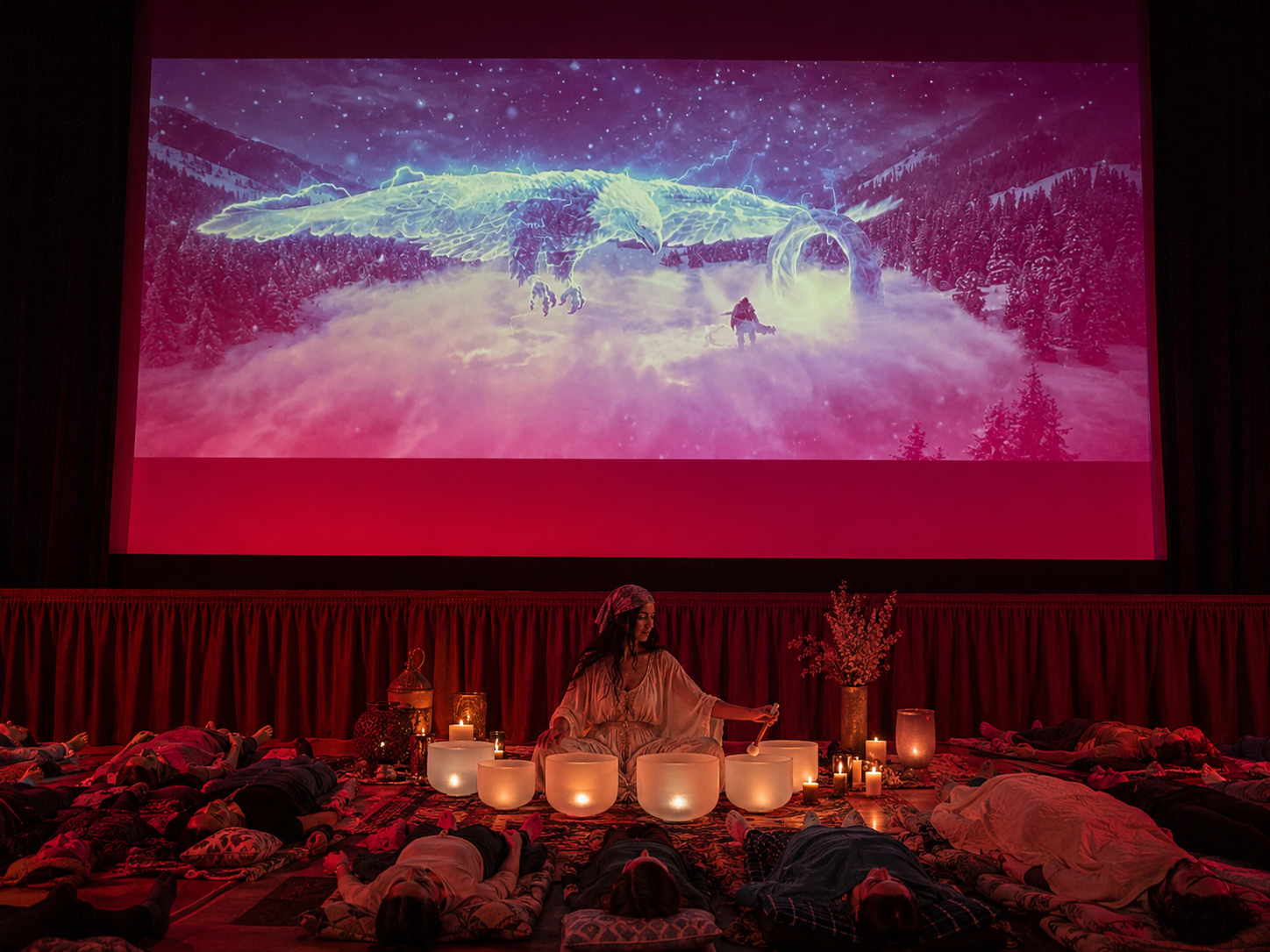
Conditioning is not only cognitive. It lives in the body: in the nervous system's learned responses to threat, in breath patterns shaped by anxiety, in the postures of collapse and rigidity we carry for years. Trauma-informed awareness and neuroplasticity tell us the same truth: the body can learn, and therefore the body can unlearn.
Noticing the pattern as it arises: the automatic response, the familiar contraction, the story that begins to tell itself.
Reading the pattern through the symbolic frameworks: what it means, where it came from, what it has been protecting.
Meeting the pattern in the body: allowing held breath to release, contraction to soften, sensation to complete itself.
Weaving the insight into lived experience, so that change is not an idea but a new way of being.
A note on rigor. The nervous system's capacity for change (neuroplasticity, the body's stress responses, the physiology of trauma) is established neuroscience. The symbolic frameworks are philosophical metaphor: maps for reflection, not empirical claims. At Aman Origins, the two are held apart deliberately, so that each can be honored for what it is.
You do not experience reality directly. You experience the story you tell about it.
The Symbolic Nature of Experience
Astrology does not claim the planets cause events. It proposes something subtler: that celestial cycles describe temperamental tendencies, developmental themes, and relational patterns we meet again and again. The chart is a starting vocabulary; the life is the text.
Explore Astrology
When two charts are overlaid, a third pattern emerges: the relationship itself. Synastry reads the points of contact and tension between two people, not to predict an outcome but to illuminate the dynamic that is already unfolding between them.
Explore Synastry
The 78 cards are a symbolic catalogue of human situations. What makes Tarot useful is not the cards themselves but your response to them: the reaction that surfaces the narrative you are already living inside. A skilled reading does not decode the cards for you; it helps you notice what you projected onto them.
Explore Tarot
The I Ching is built on a premise Western thought has resisted: that change is not an interruption of order but its fundamental nature. Its 64 hexagrams describe situations in transition, not fixed states, but conditions that contain the seeds of their own transformation.
Explore the I ChingWe begin by seeing the pattern clearly: the recurring theme, the automatic response, the story that keeps repeating across contexts.
We read the pattern through the symbolic frameworks, giving it a language and a lineage it did not have before.
We bring the insight into the body, where the pattern actually lives, allowing it to move, release, and complete itself.
We weave it all back into lived experience, so the change becomes not an idea but a new way of being in the world.

The purpose is not to tell you who you are. It is to help you see the patterns through which you experience your life.
The Aman Origins MethodIf something on this page resonated with the way you already think about your own experience, or challenged it in a way that felt productive rather than dismissive, that is a good indication this work might be useful to you.
Sessions are not performances. They are conversations. Bring your questions, your skepticism, your curiosity, your stuck places. The work begins wherever you are.
Book a Session